
Pick-and-pluck foam alternatives.
Pick-and-pluck foam is fast to shape and slow to die. Cubes loosen, tear and shed until the case rattles. There are six ways out, from a can of Plasti Dip through made-to-order foam to a printed insert, and which one is right comes down to two things; whether you own a 3D printer, and how often your gear changes.
Why pick-and-pluck foam falls apart
The foam is a block of small cubes joined by thin uncut strips. Pull cubes to make a pocket and the ones around it are held in by those strips alone. Every time a gun goes in or out, the edge cubes take the load, and they go first.
Pick-and-pluck foam
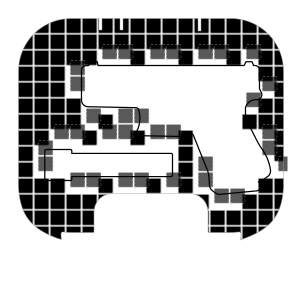
StashGrid
Owners describe the same failure across brands and decades. “It takes very little time for the other squares to start pulling out when you don’t want them to” (M4Carbine.net, 2018). A Pelican 1170 owner found the foam “tore too easily and left particles” within a year, even after coating it (r/NFA). Apache 3800 owners get blunter (“Foam sucks. Case is great!”).
The six options at a glance
| Option | Fit | When your gear changes | Wait | Cost |
|---|---|---|---|---|
| Reinforce the factory foam | Same cube grid | Removed cubes don’t go back | None | A can of Plasti Dip |
| Replacement foam set | Same cube grid | Start again with a new set | Shipping | Can be close to the case price |
| Cut your own (Kaizen or solid foam) | Depends on your tools and patience | Recut or replace | An afternoon or three | Low, plus tools |
| Made-to-order custom foam | Close, if the layout is right | Order a new insert | 12–15 business days to ship at two big vendors | Highest |
| Modular grid (DAKA, TrekPak) | Follows the grid, not the outline | Rearrange any time | Shipping | About $100 for a DAKA rifle kit |
| 3D-printed insert | Follows the digital outline; test fit needed | Edit the design and reprint | Print time | Filament, if you own a printer |
1. Reinforce the factory foam
Coat the pocket walls with a rubber spray like Plasti Dip and the loose cubes hold together for a while. One Apache owner’s advice to another: “Plastidip the hell out of the foam or it will break up quickly” (r/liberalgunowners). It buys time. It doesn’t change the cube grid, and the 1170 owner above saw tearing anyway.
2. Buy a replacement foam set
The simplest swap, and the most frustrating one: you get new foam with the same failure built in. Match the case model number exactly, since interiors differ between cases that look the same.
3. Cut your own foam
Solid or layered foam cut to the outline of your gear can fit well and costs little. People use electric fillet knives, hot wires and hot knives. The hard part is corners: an electric knife “works well until you hit corners and turns” (Snipers Hide, 2020). A slip usually means a new sheet. Kaizen foam is the popular choice here; it gets its own section below.
4. Order made-to-order custom foam
GunFoam, MyCaseBuilder, Pelican’s custom foam service and Case Club cut foam to a layout you design online. It is the closest fit you can buy without doing the work, and owners who give up on pick-and-pluck often end up here. Expect to wait: MyCaseBuilder and GunFoam both list 12 to 15 business days before custom foam ships. Case Club won’t refund any foam insert. Custom foam vs a printed insert, in detail.
5. Use a modular grid
Magpul’s DAKA GRID and Pelican’s TrekPak replace cut foam with parts you rearrange by hand. The DAKA Universal GRID rifle kit is $99.95 at Magpul: EPP foam panels and blocks you cut to your case, plus straps to hold gear down. Nothing needs recutting when the loadout changes. The catch is that a grid can’t follow a gun’s outline, so gear is held by blocks and straps rather than a shaped pocket.
6. Print an insert
A printed insert is a rigid or semi-flexible part shaped to your case and your gear. When the gear changes, you change the design and print again. Free models exist on Printables and MakerWorld, but each fits its maker’s exact gun and case. A designer like StashGrid lets you arrange supported gear in a supported case and export your own STL. The three ways to get a printed insert.
It isn’t for everyone. You need a printer and the patience to slice, print and test-fit, and the inserts for these cases are bigger than most build plates. Some owners object on principle (“The whole point of the foam is for shock absorption”, r/3Dprinting). That is a fair point, and we haven’t tested printed inserts against foam for impact yet, so we don’t claim they protect better.
What it costs
The number that sends people looking for alternatives: replacement foam for a Harbor Freight Apache can cost almost as much as the case. “Its like $3 more to buy a new case than it is to buy replacement foam. Foam on amazon is $36 case on sale is $39” (r/harborfreight, 2024). Pelican owners say the same about theirs: “they make you buy all the pieces not just the middle one” (Rokslide, 2026).
Printing flips the cost into filament and time. One maker reported “This cost $8 in material. a sheet of of Foam is $20” for a TPU insert (r/functionalprint, 2026). A full-size case is a bigger job: an Apache 2800 insert printed in four sections used “almost a whole roll” (r/harborfreight, 2025). We haven’t published our own print costs yet.
Kaizen foam vs pick-and-pluck
Kaizen is FastCap’s layered foam, sold for tool drawers and used everywhere else. You trace your gear, cut the outline and peel the layers out to the depth you want. FastCap describes it as laminated in 1/8-inch layers that separate cleanly.
| Pick-and-pluck | Kaizen | |
|---|---|---|
| Shaping | Pull cubes by hand | Trace, cut, peel layers |
| Pocket shape | Stepped along the cube grid | Follows your cut line |
| Depth control | Full depth or nothing | In 1/8-inch layers |
| Durability | Cubes loosen and tear | Firmer; peeling thin layers can tear |
| Tools | None | A sharp knife and a steady hand |
One Pelican owner summed up the trade: “Kaizen is the best for being shock protection and durable. The softer pick and pluck type stuff sold in some cases has more shock protection, but will tear and deform more easily” (r/pelicancase, 2024). The common complaint is the peel itself: go too thin and the layer tears instead of lifting.
Both are still foam you shape by hand, once. If you want the fit of Kaizen without the knife, that is the gap a printed insert fills.
Where Gridfinity fits
Gridfinity is the open-source system of 3D-printed bins on a 42 mm baseplate grid, and people search “kaizen foam vs gridfinity” for a reason: makers already use it inside hard cases. It is brilliant for drawers of small parts that move around. For a pistol it has the same limit as any grid: a bin is a rectangle, and a gun isn’t. A case-specific printed insert shapes the pocket to the gear instead.
Which to choose
Made-to-order foam
You want it finished and fitted, don’t own a printer, and can wait a few weeks.
A modular grid
Your loadout changes every trip and a loose-ish fit is fine.
Cut your own
You want the lowest cost and don’t mind an afternoon with a knife.
Reinforce or replace
You need the case working this weekend and will deal with it properly later.
A printed insert
You own a printer, want the pocket shaped to your gear, and want to reprint when it changes.
Design a printed insert for your case
StashGrid supports Apache 3800, Glock Factory Case and Pelican 1170 today. Each case page shows example layouts, insert sizes and how many pieces it prints in. Open the designer.